Project Overview
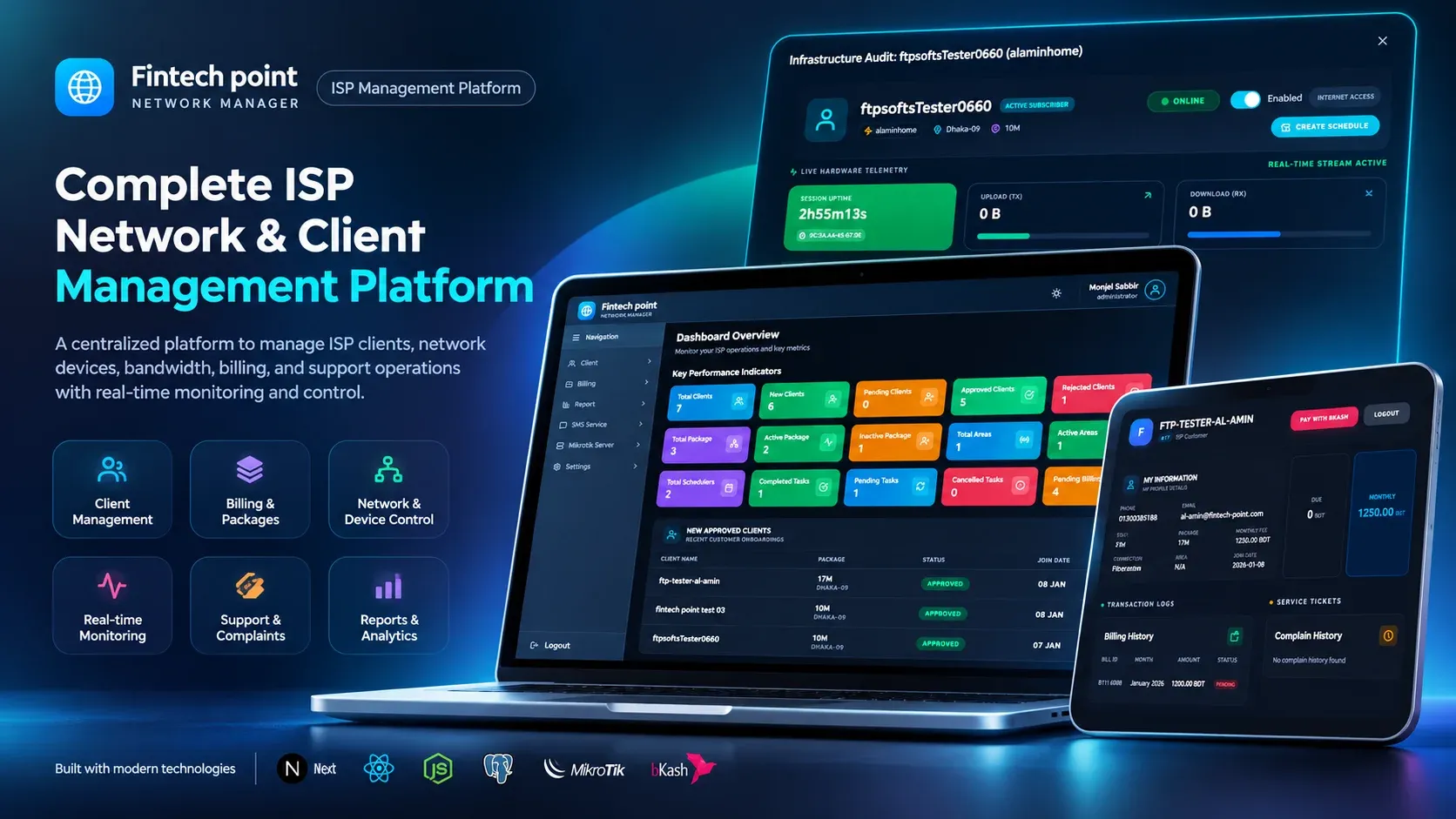
The ISP Billing & Network Management Suite is a proprietary organizational platform designed to centralize the operational workflows of an Internet Service Provider.
The system brings together customer management, billing, network monitoring, payments, support, analytics, and customer self-service within a modular application ecosystem.
It consists of three primary areas: an Admin Dashboard, Customer Self-Service Portal, and centralized Documentation module.
Business Objective
ISP operations involve several interconnected processes. Customer accounts must remain synchronized with billing, payments, network infrastructure, communications, and support activities.
The platform was developed to provide a centralized system for managing these workflows while maintaining a scalable architecture that could support continued organizational development.
My Contribution
I contributed to the design and development of this proprietary organizational solution, working on functionality across the platform while following its existing backend and operational requirements.
My work involved building and integrating frontend functionality, connecting application interfaces with the Laravel API, implementing data-driven workflows, and contributing to the modular structure of the overall system.
Admin Dashboard
The administrative application provides centralized visibility and control over day-to-day ISP operations.
Core capabilities include:
Customer lifecycle and account management
Billing-related workflows and automation
MikroTik router monitoring
SMS gateway integration
Payment management
Revenue and operational analytics
Support and complaint management
Administrative monitoring and controls
The dashboard was designed to make complex operational information easier to access and manage from a unified interface.
Customer Self-Service Portal
A separate customer-facing portal allows ISP subscribers to securely access important account functionality without depending on administrators for routine tasks.
Customers can:
Access and manage their accounts
Review billing and payment history
Make supported online payments through bKash
View relevant account information
Submit and track support complaints
The portal provides a responsive interface with both light and dark modes, maintaining a consistent experience across different devices.
Technical Architecture
The frontend applications were developed using React and Vite and integrated with a Laravel-based API backend.
Axios handles API communication, while TanStack Query is used for efficient server-state management, including data fetching, synchronization, caching, and updates across data-driven interfaces.
Monorepo Structure
The system uses a monorepo architecture to organize related applications and shared project resources.
This approach keeps the Admin Dashboard, Client Portal, and supporting modules logically separated while allowing them to remain part of a coordinated development and deployment environment.
Component | Primary Purpose |
|---|---|
Admin Dashboard | ISP operations, billing, customers, monitoring and analytics |
Client Portal | Customer accounts, billing, payments and support |
Documentation | Centralized system and operational documentation |
API Backend | Laravel-based business logic and application APIs |
ISP & Network Integration
The platform integrates ISP-specific functionality including MikroTik monitoring, connecting business-facing management interfaces with network-related operational data.
This makes the project substantially different from a generic billing dashboard. The application has to present customer, financial, support, and network information within workflows suitable for real ISP operations.
Outcome
The project demonstrates experience working on a large, multi-application business system where frontend development must integrate with existing backend APIs, payment services, networking infrastructure, and operational workflows.
It also reflects my ability to contribute to proprietary software involving billing systems, customer self-service, network management, API integration, server-state management, and modular application architecture.