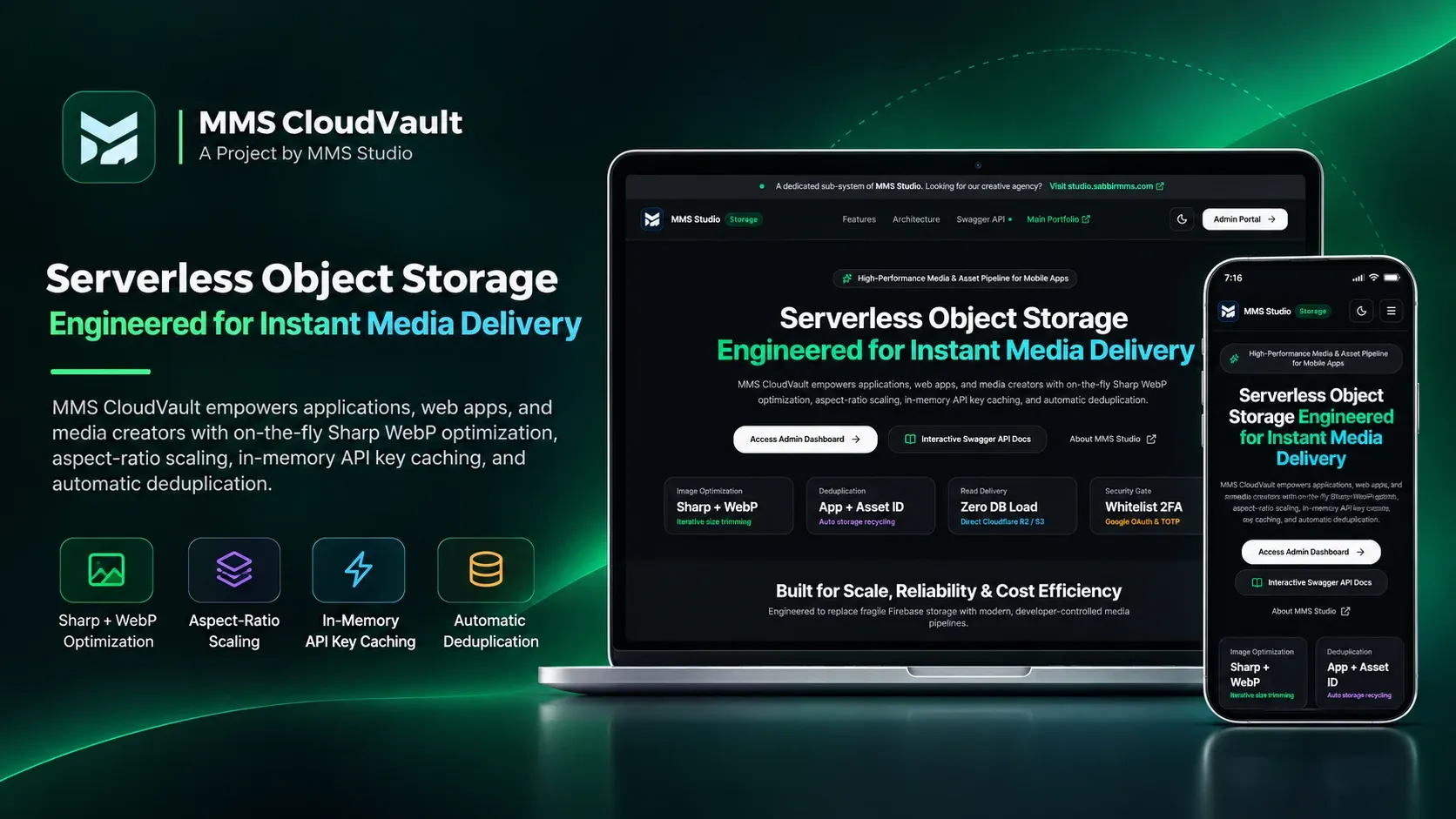
MMS CloudVault — High-Performance Serverless Media Infrastructure
Engineered for Instant Media Delivery, Intelligent Storage Management, and Enterprise-Grade Security.
Project Overview
MMS CloudVault is a high-performance media infrastructure and multi-cloud object storage management platform developed by MMS Studio. Built for modern web and mobile applications, it provides a centralized solution for uploading, optimizing, storing, securing, and delivering digital assets at scale.
The platform combines serverless technologies, intelligent image processing, S3-compatible object storage, and advanced API security to create a reliable and cost-efficient media delivery pipeline.
Unlike traditional file storage solutions, CloudVault is designed to automatically optimize media assets, prevent unnecessary storage duplication, reduce database operations, and deliver content directly through cloud storage and CDN infrastructure.
The Engineering Challenge
Modern applications frequently struggle with several infrastructure challenges:
Large Media Files: Unoptimized images increase bandwidth consumption and slow down application loading.
Storage Redundancy: Repeated uploads and outdated files create unnecessary storage costs.
Database Overhead: Repeated database lookups during media delivery increase infrastructure load.
Upload Limitations: Serverless request size restrictions complicate large media uploads.
Security Vulnerabilities: Exposed API keys and unauthorized client requests can compromise storage infrastructure.
Multi-Cloud Complexity: Managing multiple storage providers and application-specific buckets requires additional engineering.
MMS CloudVault was designed to address these challenges through a unified, developer-controlled media infrastructure.
Core Features & Architectural Innovations
1. Intelligent Image Optimization Pipeline
Built with Sharp and native libvips, CloudVault automatically processes uploaded images before storing them.
Converts supported image formats into optimized WebP assets.
Automatically resizes images while preserving their original aspect ratio.
Prevents unnecessary upscaling to maintain image quality.
Uses adaptive compression to enforce configurable file-size limits.
Generates BlurHash placeholders for progressive image loading.
The optimization pipeline is designed to reduce image file sizes by approximately 60–85%, depending on the source image and compression settings.
2. Multi-Cloud Object Storage Architecture
CloudVault supports Cloudflare R2 and other S3-compatible object storage providers through a unified storage management layer.
Key capabilities include:
Dynamic storage bucket configuration.
Application-specific storage routing.
Separate image and audio storage destinations.
Automatic bucket connectivity verification.
Direct object storage delivery through CDN endpoints.
Support for multiple storage accounts.
This architecture reduces dependence on a single storage provider and allows applications to choose storage destinations based on their requirements.
3. Automatic Asset Deduplication & Replacement
CloudVault implements an intelligent asset replacement engine using application IDs and unique asset identifiers.
When an existing asset is updated, the system identifies the previous storage object, replaces its metadata, and removes the outdated physical file.
This approach helps prevent orphaned assets, reduces unnecessary storage consumption, and maintains a consistent relationship between application records and stored media.
4. High-Performance API Key Caching
A dedicated in-memory LRU caching layer accelerates API key validation and reduces repeated database queries.
The architecture includes:
API key caching with automatic expiration.
Fast in-memory validation.
Cache invalidation when credentials change.
Reduced database operations for repeated requests.
The technical implementation documents approximately 0.03ms in-memory cache lookup performance, helping minimize authentication overhead for high-frequency API requests.
5. Direct Media Delivery Without Database Reads
CloudVault separates media delivery from application database operations.
Once an asset is uploaded and registered, clients can retrieve it directly through its cloud storage or CDN URL.
This design reduces application server involvement during asset retrieval and avoids unnecessary database reads for standard media delivery.
6. Secure Direct-to-Cloud Uploads
CloudVault supports pre-signed S3 upload URLs, allowing compatible clients to transfer large files directly to object storage without passing the binary payload through the application server.
The upload process includes:
Authenticated requests for temporary upload URLs.
Direct file transfer to the selected storage bucket.
Secure asset registration and metadata management.
Automatic replacement handling for existing assets.
This is especially useful for larger audio assets and other media files that exceed conventional serverless request limits.
7. Enterprise-Grade Authentication & Security
Security is integrated across both the administrative dashboard and the media API.
Administrative security:
Google OAuth authentication using Auth.js.
Strict email-based access whitelisting.
Time-based one-time password (TOTP) two-factor authentication.
Signed, HTTP-only session verification.
Additional 2FA verification for sensitive bulk deletion operations.
API and mobile security:
Application-specific API key authentication.
Firebase App Check integration.
Google Play Integrity verification for supported Android clients.
Cryptographic token signature validation.
Unauthorized request rejection before processing media operations.
These mechanisms provide multiple layers of protection against unauthorized access and abusive API requests.
8. Modern Administrative Dashboard & Developer API
The responsive administrative portal provides centralized control over storage infrastructure, application credentials, and media assets.
Key capabilities include:
Media gallery and asset management.
Bulk asset selection and secure deletion.
Application and API key management.
Storage bucket configuration and connectivity testing.
Detailed asset metadata and uploader attribution.
Responsive dark and light themes.
Interactive Swagger API documentation.
OpenAPI-compatible REST endpoints and Postman collection support.
The dashboard is designed to simplify complex storage operations without sacrificing developer control.
Technology Stack
Frontend: Next.js 16, React 19, TypeScript, Tailwind CSS 4, Lucide
Backend & API: Next.js Route Handlers, Node.js, REST API, OpenAPI 3.0, Swagger UI
Database: Serverless High-Availability PostgreSQL, Drizzle ORM, Composite Indexing
Cloud Storage: Cloudflare R2, AWS S3 SDK, Multi-Cloud S3-Compatible Object Storage, Pre-Signed Upload URLs
Media Processing: Sharp, libvips, WebP, BlurHash, Adaptive Image Compression
Caching: In-Memory LRU Cache, TTL-Based Expiration
Authentication & Security: Auth.js, Google OAuth 2.0, TOTP 2FA, JWT, Firebase App Check, Google Play Integrity
Performance & Engineering Highlights
60–85% targeted image size reduction through optimized WebP processing, depending on input assets.
Approximately 0.03ms in-memory API key lookup documented for the caching layer.
Zero application database reads during direct media delivery using CDN and object storage URLs.
Direct-to-cloud uploads to bypass application server payload limitations.
Automatic asset replacement to reduce redundant storage.
Application-specific multi-cloud routing for flexible infrastructure management.
Layered security controls across administrative and client-facing operations.
The project demonstrates practical experience in full-stack development, cloud infrastructure architecture, media processing, database optimization, API engineering, and application security.
Designed, Architected & Developed by MMS Studio
Engineering reliable infrastructure that makes media delivery faster, smarter, and more secure.